
An interactive book mechanism needs to do more than work once. It should move through its intended range, return or reset as designed, and continue functioning under an agreed pattern of repeated use. The review also needs to identify wear before it develops into tearing, detachment, or a mechanism that no longer operates correctly.
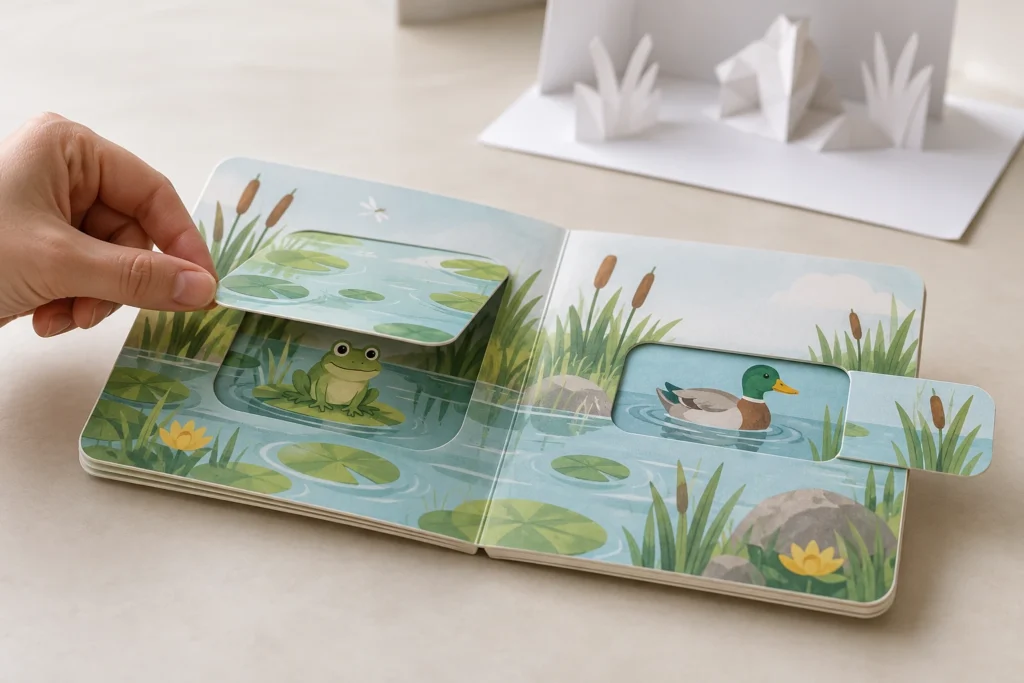
For buyers, the most useful approach combines a movement review with a documented durability evaluation. Agree on the operating method, samples, conditions, and acceptance criteria before testing so the results provide a clear basis for approval.
1. Identify Every Mechanism and Its Intended Action
Create a mechanism list using page or spread numbers and unique identifiers. Include each flap, slider, wheel, pop-up, and linked movement, even where several features share one spread.
The Robert C. Williams Museum of Papermaking’s mechanism overview distinguishes features operated directly by the reader from pop-ups activated by opening a page. That distinction affects how each feature should be reviewed.
For every mechanism, record the starting position, operating direction, permitted travel, and intended result. Identify any reset required before closing the book. Where a feature needs manual repositioning, make that part of the approved instructions.
| Mechanism | Movement to review | Wear or failure to watch for |
|---|---|---|
| Lift-the-flap | Opening to the intended position and closing over the correct area | Hinge splitting, corner lifting, surface separation, and incomplete closure |
| Pull-tab or slider | Travel along the intended path and return to the starting position | Jamming, buckling, slot wear, damaged stops, and separation of the tab or linkage |
| Rotating wheel | Turning through the permitted range while remaining retained | Catching, rubbing, worn openings, looseness, and pivot damage |
| Page-action pop-up | Deployment during opening and collapse during closing | Collisions, reversed folds, torn attachment points, and pieces trapped outside the book |
| Linked mechanism | Correct sequence and coordination between moving parts | One component lagging, obstructing another, or preventing the assembly from resetting |
2. Know What the Sample Represents
Record whether the sample is an early structural model, a decorated prototype, or a production-representative book. Confirm the stock, finished construction, coatings, adhesives, cutting method, and assembly process used.
A white prototype is valuable for checking geometry, but it may not reproduce the stiffness, friction, or attachment behavior of the finished materials. Papersmyths’ development process includes checking the mechanisms again in a complete color mockup after the initial engineering stage.
Ask the manufacturer to identify substitutions and any special preparation. Record whether the sample has already been repeatedly operated, adjusted, repaired, or manually eased into movement.
Agree on when it is ready for evaluation, including any required adhesive curing or conditioning. Keep an identifiable untested reference where practical, and allocate separate samples for inspections that will damage or dismantle the structure.
3. Review the First Operation Before Repeated Testing
Start with the book in its normal closed or starting condition. Support it as specified and use the intended operating point, such as the flap edge, tab grip, or exposed wheel section.
Observe how easily the feature begins to move. Check whether the grip is accessible and whether the direction is understandable from the design and instructions.
Move through the full intended action at the agreed speed. Watch the beginning, intermediate positions, and endpoint. A structure can look correct when fully open yet catch or buckle halfway through its travel.
Record unexpected resistance or failure before attempting any correction. If a sample needs adjustment to operate, identify that intervention instead of treating the corrected action as its original performance.
Review more than one specimen when production consistency matters. One carefully assembled demonstration sample provides limited evidence about variation across a manufacturing run.
4. Check Travel, Stops, and Return Movement
Confirm that the mechanism reaches its intended position without requiring the reader to bend the tab or pull in an unintended direction. For sliders and wheels, check retention and any designed travel limits.
Return the feature to its starting state. Look for incomplete retraction, changed picture alignment, folded corners, or a linkage that catches during reverse movement.
A wheel may have a limited arc rather than unrestricted rotation. A flap may have a specified opening angle. Obtain the intended limits before evaluating either feature.
Describe operating resistance consistently. If force is a contractual requirement, agree on the measurement setup, support, grip point, direction, speed, equipment, and units. Hand-feel descriptions alone do not establish a reproducible force limit.
Assess overtravel, excessive force, or other misuse under a separately defined scope where relevant. Keep those results distinguishable from normal-operation testing.
5. Review Closing and the Complete Bound Book
Test the return path and closing action as carefully as deployment. Reset manually operated features according to the approved instructions, then close the spread normally.
Check whether folds follow the intended path, pieces interfere, or edges remain outside the book. Note any need to tuck, press, or guide a component beyond the approved operating sequence.
Turn neighboring pages and repeat the review in the complete bound book. A mechanism that works on an isolated spread may behave differently after mounting, binding, or the addition of adjacent structures.
Check the overall closed condition, page attachment, cover behavior, and any pressure on the mechanism from surrounding components. Where an enclosure is included, review the book’s fit after the features have been correctly reset.
6. Define a Repeatable Durability Method
Choose a repeated-use evaluation suited to the intended audience, design, materials, and any relevant performance claims. Agree on the method and required evidence for the specific project rather than borrowing a cycle count from an unrelated book.
Define one complete cycle clearly. For example, a slider cycle could mean moving from its approved starting position to the approved endpoint and back. A pop-up cycle could mean opening a spread to the specified angle and closing it through the intended fold path.
Keep mechanism cycles distinguishable from complete-book reading cycles. Opening the covers alone does not exercise every manually operated feature.
Before starting, agree on:
- The specimens and mechanisms included.
- Cycle count, operating rate, and inspection checkpoints.
- Book orientation, support, grip position, travel, and reset sequence.
- Conditioning and environmental requirements, where specified.
- Permitted preparation and any pauses or rest periods.
- Wear limits, functional acceptance criteria, and stopping rules.
Record any departure from the method. Faster movement, a changed grip, or an altered opening angle can produce a different evaluation. A cycle result documents performance under the stated conditions; it does not establish a precise number of years of reader use.
7. Inspect Wear at Agreed Checkpoints
Pause as planned to compare the mechanism with its baseline condition. Observe both its appearance and its operating behavior.
Look for developing splits at folds, exposed fibers, elongated slots, edge lifting, loosening attachments, and rubbing or cracking of surface treatments. Check whether motion becomes less smooth or the endpoint and return position change.
Examine the attachment zones and nearby page material. An intact glue joint can still be accompanied by tearing in the paper around it. Conversely, a sticking mechanism may result from interference rather than an adhesive failure.
State Library Victoria’s discussion of movable-book damage describes how design, assembly, mechanical stress, and handling can contribute to wear. Use observed evidence to guide investigation rather than assuming every failure has the same cause.
Separate cosmetic changes from operating failures and damage requiring further safety assessment. Agree on acceptable appearance changes in advance; a working mechanism can still fall outside an agreed visual standard.
8. Record Failures Without Losing the Evidence
When an issue occurs, record the sample identifier, mechanism, action, and stage of testing. Photograph the affected area and capture the movement on video where useful.
State how many cycles were completed and what happened during the next action. If inspections occur only at intervals, record the interval in which deterioration was discovered rather than claiming an exact failure cycle.
Describe the symptom precisely: the slider stopped before its endpoint, a flap hinge split, a glued tab lifted, or the structure required assistance to close. Preserve the sample in its observed condition until the cause has been assessed.
Do not quietly repair, lubricate, trim, or rebond a specimen and continue counting it as unchanged. Identify any intervention, retain the original result, and use an agreed procedure for evaluating the revision.
9. Confirm Production and Safety Review Requirements
Distinguish routine functional inspection from sample-based repeated-use testing. Agree on how production specimens will be selected, which mechanisms are covered, and how differences between units will be reported.
Check that the reviewed construction matches the released material list, cutting files, adhesive arrangement, finishes, and assembly instructions. Record changes that could affect friction, strength, attachment, or closing behavior.
For children’s products, define the intended age group, destination market, product classification, and responsibility for applicable testing and documentation. The CPSC’s children’s books guidance explains limitations of the U.S. exemption from total lead content testing for ordinary books, including age and play-value considerations. The appropriate scope also depends on the actual materials and relevant exceptions.
Functional cycle checks provide one part of the review. Any applicable safety evaluation needs its own defined scope, including assessment of components that may loosen or detach during use.
10. Use a Clear Review Record
| Record item | Information to include |
|---|---|
| Sample identity | Title, version, specimen number, production stage, and batch where available |
| Mechanism identity | Page or spread, unique feature identifier, and structure type |
| Construction | Stock, coatings, adhesive arrangement, cutting and assembly references, and substitutions |
| Starting condition | Previous operation, preparation, curing or conditioning status, and existing defects |
| Operating method | Orientation, support, grip, travel, speed, opening angle, and reset requirements |
| Cycle plan | Definition of a cycle, target count, checkpoints, and stopping rules |
| Acceptance criteria | Required function, permitted wear, attachment requirements, and approved references |
| Observations | Completed cycles, changes in movement, wear, failures, and deviations from the method |
| Evidence | Dated photographs, video references, measurements where specified, and retained sample |
| Decision | Approved scope, unresolved points, corrective action, and required verification |
For remote reviews, share a short operating video showing the complete action and return path. Include enough context to identify the mechanism and how the book is supported. Use close-ups for the defect rather than relying only on a polished demonstration.
11. Verify Corrections Before Final Approval
Ask the manufacturer or paper engineer to identify the proposed change and the evidence supporting it. A revision may involve material, fold geometry, clearance, attachment area, or assembly positioning.
Give the revised construction a new reference. Repeat the relevant movement and durability checks, including interactions with neighboring features and complete-book closing where the change could affect them.
Record what has been approved and what remains outstanding. Keep the tested version identifiable so production and inspection teams work from the same requirements.
Discuss Your Interactive Book Project with Runsheng Printing
Developing an interactive book project in China? Share your mechanism list, intended audience, structural references, material requirements, and quantity with Runsheng Printing. Include the movement you expect and any durability requirements that need to be reflected in sampling and inspection.
Explore our Knowledge Center for related guidance, or contact our team to discuss sample development, review criteria, and the quotation scope for your project.
Leave a Reply