
Lift-the-flap, pull-tab, and pop-up books offer different ways to reveal information and involve the reader. A flap uncovers something, a tab gives the reader control over movement, and a pop-up creates a dimensional scene. The right choice depends on what the interaction should communicate and how the book will be used.
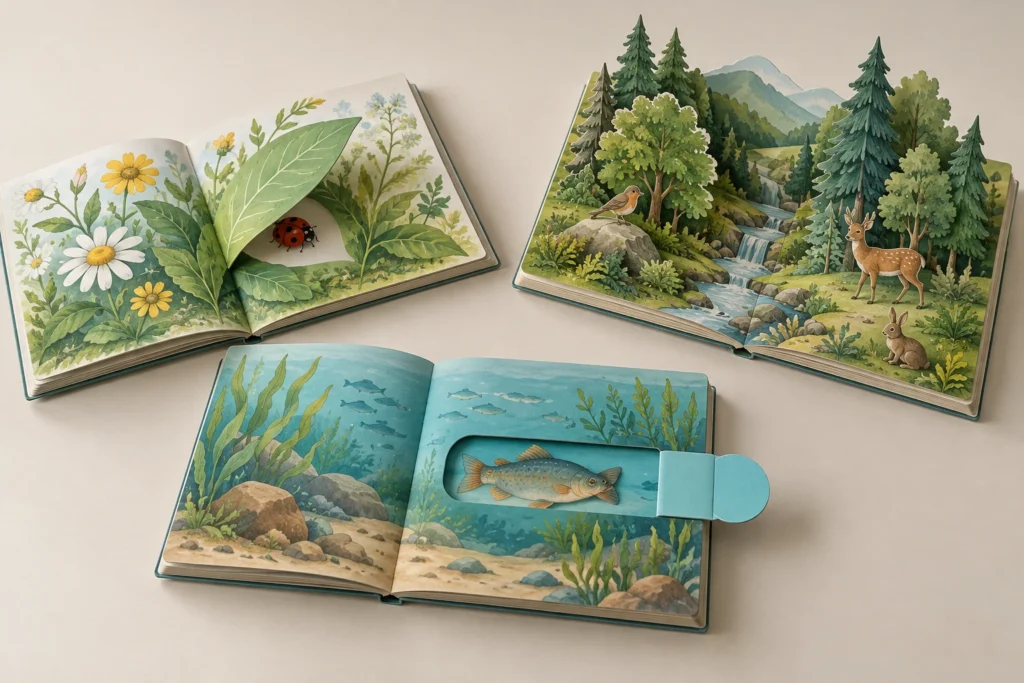
For publishers, educational brands, museums, and gift businesses sourcing custom books from China, format selection also affects artwork, paper engineering, assembly, sampling, and packaging.
This guide compares the three approaches and explains how to choose a format around the reader, the content, and the production requirements.
1. Compare the Main Reader Actions
The Robert C. Williams Museum of Papermaking at Georgia Tech distinguishes mechanisms operated through tabs or other controls from page-action structures that move as the spread opens. This is a useful starting point for discussing the experience you want.
The categories can overlap. A pull tab can activate a raised structure, and a pop-up spread can include flaps. Describe the actual action in your brief rather than relying only on a format name.
| Comparison point | Lift-the-flap | Pull-tab | Pop-up |
|---|---|---|---|
| Main action | Lift a hinged panel | Slide or pull a control | Open a spread to raise a structure, sometimes with additional actions |
| Useful content effect | Reveal a picture, answer, or hidden layer | Show movement, change, or a sequence | Present depth, spatial relationships, or a dramatic scene |
| Reader control | Choose when to reveal | Control the movement or reveal | Control page opening and any added features |
| Structural focus | Hinge, access, and attachment | Travel, guidance, retention, and return | Movement, clearances, support, and closing |
| Artwork focus | Outside, underside, and revealed content | Alignment throughout the movement | Visible surfaces, folds, and overlapping pieces |
These are planning comparisons. Each proposed design still needs a working sample and a manufacturing review.
2. Choose Lift-the-Flap for Discovery and Layered Information
A flap works well when the content benefits from concealment followed by a reveal. It can uncover an animal, show an answer, expose a labeled detail, or reveal what is inside an illustrated object.
The interaction can be brief and easy to understand. Readers decide when to lift the panel and can revisit the content beneath it. For reference or educational projects, several flaps can organize information into distinct discoveries.
Plan the flap’s size, hinge position, opening direction, and grip. Check that the reader can reach it without bending another part and that its underside is oriented correctly when lifted.
A flap may be formed within a page layer or attached as a separate component. Those constructions can involve different materials and assembly work. Ask how the proposed design is built rather than assuming all flap books use the same process.
“Lift-the-flap” describes the interaction. “Board book” describes a construction approach. A flap book is not automatically a board book, and its durability needs to be assessed from the actual materials, hinge, and attachment.
3. Choose Pull-Tab for Movement the Reader Controls
A pull tab can animate an illustration, change a picture, reveal a sequence, or operate a linked mechanism. It is useful when the movement itself carries information: a character changes position, an illustrated object opens, or two states are compared.
The reader controls the action by moving the tab. This can make a process or transformation more explicit than a single concealed image. The design needs to make the intended movement clear.
Review where the tab sits, how it is gripped, how far it travels, and what prevents it from being pulled out unintentionally. Check that it returns as intended and does not catch inside the page construction.
Artwork needs to work at the start, end, and relevant intermediate positions. A picture may align correctly in one position but reveal an unintended blank area or obscure text during movement.
Include the required operating sequence in the brief. If the tab must return before the book closes, confirm whether that action is clear and appropriate for the intended reader.
4. Choose Pop-Up for Depth and a Strong Spatial Reveal
A pop-up structure rises from the page to form a dimensional scene. It can help present the relationship between parts of a landscape, building, creature, or object, or provide a focal reveal in a story or presentation.
This format can suit children’s publishing, museum and cultural projects, collector editions, and branded gift books. The subject and intended handling should determine the construction.
Review how the structure forms as the spread opens and how it folds back when closing. Components need suitable supports, folds, attachment positions, and clearance from neighboring pieces. The complete book also needs space for the folded layers.
Agree the intended opening position and how the book will be held or displayed. A scene intended for a table may need a different review from one usually handled in the reader’s hands.
The raised scene should serve the content. If the main requirement is simply to uncover a small answer, a flap may achieve the objective with a different development and production scope. Ask the engineer to explain the practical alternatives.
5. Match the Interaction to the Reader and Setting
Consider the reader’s ability to grip, lift, pull, and follow an operating sequence. Also consider adult guidance, shared reading, repeated classroom use, retail browsing, or occasional display.
Avoid choosing from a fixed age ranking of the three formats. A broad flap and a tiny nested flap create different handling demands. The same is true of a simple slider and a mechanism with several linked movements.
Have representative users review the proposed interaction where appropriate, and use their observations to refine access, instructions, and complexity. Keep claims about suitability tied to the actual design.
For children’s projects, identify the intended age and destination market early. CPSC’s children’s books guidance explains that the US exemption from total lead content testing for ordinary books has exclusions, including books with inherent play value and books intended for children aged three or younger. Review the actual construction and applicable requirements rather than assuming a format name establishes an exemption.
6. Compare Cost and Durability Through the Construction
There is no dependable universal price order for flap, pull-tab, and pop-up books. Cost depends on the number of spreads, separate components, materials, printing, cutting, attachment operations, assembly, checks, and packing.
Robert Sabuda’s production FAQ identifies glue points and paper use as cost considerations in movable-book production. For buyers, counting interactive features alone leaves important work unaccounted for.
A book with many separately attached flaps may involve substantial assembly. A pull-tab design may need layered pages and internal guides. A pop-up scene can be relatively simple or contain many interdependent parts. Ask the manufacturer which operations drive the proposed price.
Durability also depends on construction. Review hinge behavior, material strength, attachment, repeated folding, operating resistance, and the way the book closes. Thicker material is not automatically a solution for every moving component.
Agree functional checks for the intended use, including the method, sample quantity, and acceptance criteria. Avoid treating one demonstration or an arbitrary cycle count as proof of long-term performance.
When requesting alternatives, hold the communication objective, quantity, and delivery scope consistent, then identify differences in construction and materials. This makes the commercial comparison easier to assess.
7. Combine Formats Where Each Action Has a Purpose
A hybrid book can use flaps for secondary discoveries, a slider for one movement, and a pop-up for the main scene. It can also combine interactive spreads with flat reading pages.
Plan the sequence deliberately. The reader should understand what to do first, where to look, and whether a feature needs resetting before turning the page. Check that an open flap or extended tab does not interfere with another mechanism.
Combining formats adds surfaces and actions to review. Record every component, instruction, printed side, and operating position in the storyboard and engineering brief.
Use the overall reading experience to decide how much interaction is useful. A quiet supporting spread can provide room for text and prepare the reader for a more elaborate opening later in the book.
8. Use the Project Goal to Narrow the Options
The following examples are starting points for discussion with the designer and manufacturer. They are not exclusive rules.
| Project goal | Format to explore first | What the sample should demonstrate |
|---|---|---|
| Reveal an answer or a hidden image | Lift-the-flap | Clear access, a suitable hinge, and readable revealed content |
| Show a change controlled by the reader | Pull-tab | Understandable movement, correct image alignment, and reliable return |
| Present the depth or arrangement of a scene | Pop-up | A clear spatial effect, controlled movement, and suitable closing |
| Offer several discoveries around a main illustration | Flaps or a hybrid layout | An organized reading path and independently usable features |
| Create a focal reveal in a premium presentation | Pop-up or a selected hybrid spread | The intended display effect, handling method, and closed fit |
For example, a nature title could hide an insect beneath a leaf-shaped flap, use a tab to demonstrate an illustrated movement, and reserve a pop-up for a habitat scene. Each interaction would communicate something different.
The design review should establish whether those actions clarify the content and fit the reader, budget, and production plan.
9. Review Artwork, Sampling, and Packing Before Committing
All three formats need artwork coordinated with the structural design. Flaps add outside and underside surfaces; sliders require images to align during travel; pop-ups may reveal reverse surfaces and obscure content as they move.
Use approved templates and component identifiers. Confirm cut and fold information, bleed, attachment areas, and the pairing of printed sides. For language editions, review text length and reading direction within the working structure.
Start with physical mechanism trials or a structural dummy where development is needed. Then review an assembled color sample so content, artwork, and interaction can be checked together. Identify differences between sample materials or methods and planned production.
Review packing with the completed construction. Flaps should be protected from unintended lifting, tabs from bending or snagging, and raised structures accommodated safely in their folded positions. Confirm the packing method and any shipping tests required for the actual book and route.
A sample approval should identify the revision and the scope accepted. Keep later production checks and unresolved items visible in the approval record.
10. Send a Brief That Describes the Actual Interaction
Give the manufacturer the information needed to evaluate the design:
- The intended reader, purpose, and destination market.
- Closed size, orientation, cover and binding preferences.
- Number of reading spreads and interactive features on each spread.
- What the reader should reveal, move, or see in three dimensions.
- Storyboard, references, artwork, or engineering files available.
- Quantity by title, language, or edition.
- Budget scope, packaging needs, and required arrival date.
Ask for the proposed construction, development stages, sample scope, and quotation assumptions. If the format is still open, request a small number of alternatives that achieve the same content objective, with their cost, handling, and production implications explained.
The format decision becomes more useful when it results in an agreed reader action, a testable structure, and a clear manufacturing specification.
Discuss Your Interactive Book Concept
Choose the interaction that supports the content, then develop the materials and construction around it. A working sample provides the basis for confirming that the proposed experience suits the project.
Explore custom pop-up book printing with Runsheng Printing and share the discoveries, movements, or dimensional scenes you want to create. Contact our team to discuss the format and manufacturing requirements for your book.
Leave a Reply