
An 80 gsm paper is not necessarily thicker than a 70 gsm paper. Two books with the same size, page count, and paper gsm can have different spine widths. A book that feels thicker may even weigh less.
These differences come from three related but distinct measurements: grammage, thickness, and bulk.
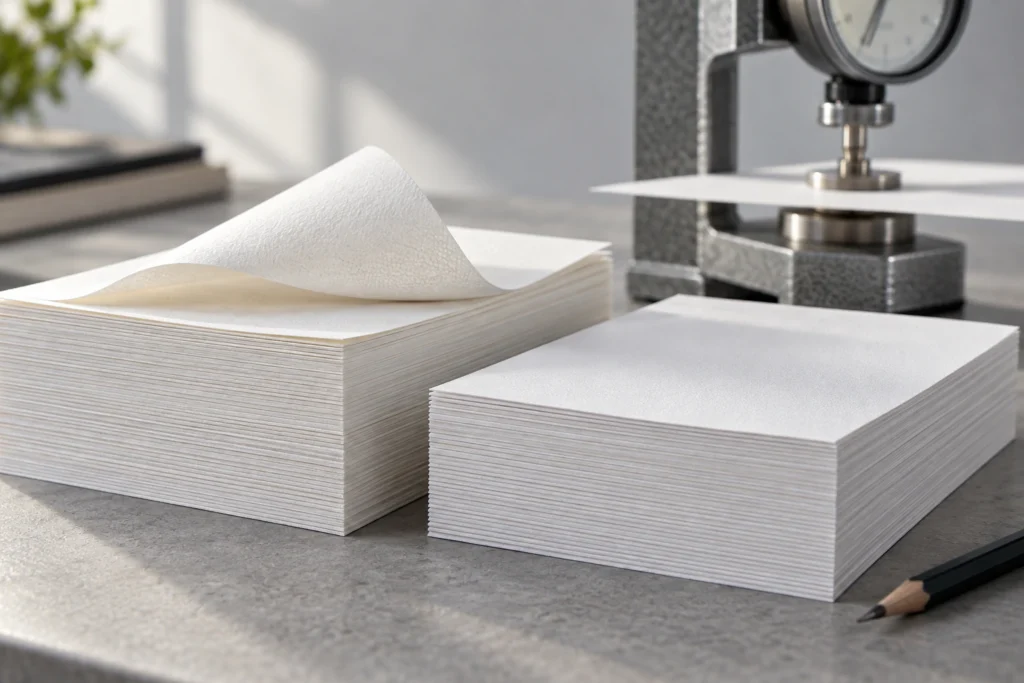
For book buyers, understanding them helps prevent misunderstandings about paper specifications, cover artwork, finished weight, and packaging. It also makes quotations from different printers easier to compare.
The key is straightforward: use GSM to understand paper mass, caliper to understand sheet thickness, and bulk to understand the relationship between thickness and mass. Review opacity, stiffness, surface, and print performance separately.
GSM, Thickness, and Bulk at a Glance
| Measurement | What it describes | Common unit | Main purchasing question |
|---|---|---|---|
| Grammage, commonly called GSM | Mass per unit area of paper | g/m², usually written as gsm | How much does a given area of paper weigh? |
| Thickness, also called caliper | The measured thickness of the sheet | Micrometers, written as µm, or millimeters | How thick is the paper, and how much space will the pages occupy? |
| Bulk | Volume per unit mass of paper | cm³/g | How much thickness does the paper provide for its grammage? |
None of these measurements is a complete quality rating. A suitable book paper balances the required properties against the reader’s needs and the production specification.
What Does Paper GSM Mean?
GSM means grams per square meter. An 80 gsm sheet has a nominal mass of 80 grams for one square meter of paper, regardless of the size into which that paper is cut.
A small page and a large page can both use 80 gsm paper. The larger page weighs more because it has more area, not because its gsm is different.
For example, a finished sheet measuring 150 × 230 mm has an area of 0.0345 m². At 80 gsm, its theoretical paper mass is:
0.150 × 0.230 × 80 = 2.76 grams.
Printing on both sides does not double the amount of paper. One physical leaf still has two page surfaces.
Grammage is a measured paper property; ISO 536 provides a method for determining it. When discussing an order, distinguish the paper’s nominal gsm from the agreed material tolerances and inspection method.
What Does Paper Thickness Mean?
Thickness describes the distance between the two surfaces of the paper under the specified measurement conditions. Printers and paper suppliers often call it caliper.
Book paper thickness is commonly given in micrometers:
- 1,000 µm = 1 mm.
- 100 µm = 0.100 mm.
- 140 µm = 0.140 mm.
Small differences matter when many leaves are stacked together. An extra 0.040 mm per leaf adds 4.8 mm across 120 leaves in a simple paper-only calculation.
Ask how the published thickness is measured. ISO 534 distinguishes single-sheet thickness from thickness calculated using a pack of sheets. The methods can give different results, so compare values on a consistent basis.
If a quotation uses paper-caliper points or mils, confirm the unit. In U.S. paper-caliper notation, one point or one mil means 0.001 inch, equivalent to 25.4 µm. These are thickness units, not gsm, and paper-caliper points are different from typographic points used for font sizes.
What Is Paper Bulk?
Bulk describes how much volume a given mass of paper occupies. It is commonly expressed in cubic centimeters per gram, or cm³/g.
Higher bulk means lower apparent density: the paper provides more volume for the same mass. Lower bulk means a more compact sheet. Holmen’s paper bulk guide explains this relationship between density, grammage, and thickness.
Using thickness in micrometers and grammage in g/m², the relationship is:
Bulk (cm³/g) = thickness (µm) ÷ grammage (g/m²).
Rearranging it gives:
Thickness (µm) = grammage (g/m²) × bulk (cm³/g).
For an illustrative 80 gsm paper with a bulk of 1.25 cm³/g:
80 × 1.25 = 100 µm.
Another illustrative 80 gsm paper with a bulk of 1.75 cm³/g would have a calculated thickness of 140 µm. The second sheet is thicker even though both have the same grammage.
Use the supplier’s confirmed caliper for production planning. If published gsm, bulk, and thickness values do not align, ask the supplier to reconcile the units, measurement basis, and declared figures before relying on them.
A Practical Comparison for a 240-Page Book
Consider a conventional book with 240 interior pages, including any blank pages. Printed on both sides, that means 120 physical leaves.
The following values are constructed examples to demonstrate the calculations. They are not paper recommendations, stock availability claims, or finished spine specifications.
| Illustrative paper | GSM | Bulk, cm³/g | Calculated sheet thickness | Paper-only stack thickness for 120 leaves |
|---|---|---|---|---|
| Paper A | 80 | 1.25 | 100 µm | 12.0 mm |
| Paper B | 80 | 1.75 | 140 µm | 16.8 mm |
| Paper C | 60 | 2.00 | 120 µm | 14.4 mm |
This comparison shows two useful points:
- Paper A and Paper B have the same grammage but different thicknesses. For the same page dimensions, their theoretical paper mass is identical.
- Paper C has a lower grammage than Paper A but is thicker. A lower-gsm paper does not automatically produce a thinner book.
The estimated paper-only thickness is calculated as:
Stack thickness (mm) = number of leaves × sheet thickness (µm) ÷ 1,000.
For Paper B:
120 × 140 ÷ 1,000 = 16.8 mm.
The important distinction is between pages and leaves. Multiplying 240 pages directly by the sheet caliper would double this estimate incorrectly. Inserts, endpapers, foldouts, and unusual constructions need their own assessment.
Why This Calculation Is Not Your Final Spine Width
A paper stack calculation helps compare materials. It does not define the final cover template.
The finished text block and spine also depend on construction and production factors, including folded sections, sewing where specified, adhesive, compression, and any additional components. Hardcover case dimensions introduce further requirements.
Ask the printer to confirm the spine width for the exact paper, page count, and binding. For an important thickness or handling requirement, review an appropriate mockup made with the proposed materials.
Finalize the cover artwork against the printer’s template after those details are settled. If the paper grade, caliper, page count, or binding changes, request confirmation that the template remains valid.
This is particularly useful for series, boxed sets, slipcases, and books that must fit a fixed package. A small change repeated across several volumes can affect the overall fit.
How to Estimate the Interior Paper Weight
For conventional rectangular leaves using one paper stock, a simple estimate is:
Interior paper mass (grams) = page width (m) × page height (m) × number of leaves × GSM.
For the same 240-page book at a trim size of 150 × 230 mm, using Paper A or Paper B:
0.150 × 0.230 × 120 × 80 = 331.2 grams.
Using the illustrative 60 gsm Paper C:
0.150 × 0.230 × 120 × 60 = 248.4 grams.
The difference is 82.8 grams of interior paper per copy, or 82.8 kg across 1,000 copies. Paper C also produces a thicker paper-only stack than Paper A in this example.
These figures exclude ink, covers, endpapers, adhesive, boards, jackets, inserts, and packaging. They estimate the paper retained in the finished interior, not the total production paper purchased, which also involves press layout, trimming, and manufacturing waste.
Use a representative finished-book weight and the agreed packing plan for shipment quotations. Estimated interior paper mass alone is not a shipping weight.
Thickness Does Not Tell You Everything About Opacity or Strength
Bulk can be useful when a project needs a substantial feel at a manageable weight. It does not replace checks for the other properties that affect the reader’s experience.
Opacity: Will printing on the reverse distract the reader? Review the proposed stock with representative double-sided pages, especially dark photographs behind light text areas. Do not infer opacity from gsm or thickness alone.
Stiffness and page turning: Does the sheet have an appropriate feel for the size of the book? A page can be thick without having the bending behavior you expect. Paper construction, grain direction, and the finished format also matter.
Print reproduction: Does the surface suit the artwork and printing process? Smoothness, coating, shade, and ink interaction remain separate considerations.
Handling performance: Does the complete paper and binding specification support the intended use? A thick sheet is not an automatic guarantee of tear resistance, page security, or long service life.
Mill datasheets such as the UPM Book creamy 1.8 specification list grammage, bulk, opacity, and thickness separately. Treat them as related properties that answer different questions.
Choosing Around the Book’s Purpose
For a long novel or reference volume, review overall weight, opacity, comfortable page turning, and the maximum acceptable book thickness. Higher bulk may create an appealing substantial volume, but it may be impractical if the book is already thick.
For a textbook carried between lessons, consider the total load on the reader. A suitable lower-gsm stock may help reduce weight, provided readability, opacity, printing, and handling remain appropriate.
For a workbook or journal, writing performance comes first. Test the intended pens or pencils and review marks on the reverse. Extra thickness alone does not establish that a paper suits the writing activity.
For a photography or illustrated book, review reproduction quality and the desired tactile effect alongside weight and caliper. A high bulk number does not establish suitability for detailed color work.
For a series or boxed set, agree dimensional requirements across titles. Matching gsm across every volume does not guarantee matching spine widths or a consistent finished feel.
Discuss the tradeoffs with the printer rather than choosing a universal gsm range for an entire book category.
Cost, Freight, and Storage: Look at Both Mass and Volume
Higher bulk at the same gsm does not reduce the theoretical paper weight for the same page area and count. It increases the volume occupied by the paper.
A lower-gsm, higher-bulk alternative may reduce book weight while maintaining useful thickness. Whether it lowers the project cost depends on the grade price, availability, sheet or reel format, production requirements, and the resulting packing plan.
Freight and storage also involve both weight and space. A thicker book can reduce the number of copies that fit into a carton or onto a pallet. A lighter book may offer a different advantage, depending on the shipment’s weight and volume constraints.
When comparing options, request the estimated finished-book weight, dimensions, carton quantity, carton size, and shipment totals. Assess the complete quotation rather than translating a paper-weight reduction directly into a freight-saving percentage.
What to Ask Your Printer Before Approving the Paper
For a book printing order from China, request an identified paper specification rather than a description such as “80 gsm premium paper.” Confirm:
- Paper identity: manufacturer and grade where specified, or an agreed material description and reference sample.
- Grammage: nominal gsm and any agreed acceptance requirements.
- Thickness: caliper, unit, and measurement basis.
- Bulk: the value and unit if it is important to your selection.
- Surface and shade: coated or uncoated, finish, and paper color.
- Relevant performance: opacity, print reproduction, writing suitability, or other project priorities.
- Book construction: compatibility with the trim size, page count, binding, and opening requirements.
- Approval and dimensions: what the sample demonstrates, the confirmed spine template, and any packaging fit requirements.
Technical datasheets often describe typical or target values rather than a guarantee that every individual sheet will measure identically. Agree the relevant acceptance basis before production and compare samples using a consistent method.
For repeat orders, retain the approved paper identification and reference. If an alternative stock is proposed, review the full set of relevant properties; matching the original gsm alone does not establish equivalence.
Frequently Asked Questions
Is higher GSM always better for books?
No. It increases paper mass per unit area, but it does not independently establish thickness, opacity, durability, or print quality. Select the stock around the intended use.
Can 70 gsm paper be thicker than 80 gsm paper?
Yes, if its bulk is sufficiently higher. Confirm the caliper for the actual grades rather than judging by gsm alone.
Does high-bulk paper always make a lighter book?
No. At the same gsm, page area, and page count, the theoretical interior paper mass is unchanged. A weight reduction requires a change such as lower grammage or a smaller format.
Can I calculate a paperback spine using page count and caliper?
You can estimate the paper-only stack thickness. The final spine dimension must account for the chosen materials and construction and should be confirmed by the printer.
Will the same GSM produce the same result on a reprint?
Not necessarily. Caliper, bulk, shade, surface, opacity, and printing behavior may differ between grades. Identify the approved stock and review any proposed substitution.
Specify the Paper and the Finished Book Together
GSM tells you mass per area. Caliper tells you sheet thickness. Bulk connects the two. Use these measurements together, then check the printed result, handling, finished dimensions, and packing requirements.
Runsheng Printing can help you assess paper and binding options against your book’s requirements. Send us your specifications, including size, page count, quantity, intended use, and delivery destination. If you have a target book weight, spine thickness, or reference sample, include it so that suitable alternatives can be assessed.
Leave a Reply